9 Best Quiet Keyboards for Office Work (November 2026)
The best quiet keyboards for office work include the Logitech MK335 Full Size Quiet Wireless Keyboard for a quiet wireless desk, the Logitech Signature Slim K950 Wireless Keyboard for switching between devices, and the HP 150 Wired Keyboard for a simple wired desk.
On this page (4 sections)
The Logitech MK335 is the best quiet keyboard for office work for most people, combining low-profile, whisper-quiet keys with a wireless mouse. Choose the K950 to switch between three devices, or the HP 150 if you prefer a straightforward wired keyboard.
A quiet keyboard can make shared work easier, especially when nearby coworkers are on calls or concentrating. We compared the connection types, key designs, layouts and office controls described for these picks.
For help choosing a layout and connection for your desk, start with our best keyboard for computer setups guide. If you know you want a wireless setup, see our best quiet wireless keyboard picks.
Our picks at a glance
-
1
 Best for a quiet wireless desk
Logitech MK335 Full Size Quiet Wireless Keyboard
9.7/10 our score
See it on Amazon -
2
 Best for switching between devices
Logitech Signature Slim K950 Wireless Keyboard
9.6/10 our score
See it on Amazon -
3

- 4
 Best for frequent office typingCheck it
- 5
 Check it
RECCAZR Wireless Keyboard and Mouse Combo Silent
Best for shared desks with a mouse - 6
 Check it
SOLAKAKA KI99 Pro Wireless Mechanical Keyboard
Best for quieter mechanical typing - 7
 Check it
ONIKUMA GAMING Tri-Mode Wireless Keyboard
Best for a compact shared workspace - 8
 Check it
Kensington Slim Type Wired Keyboard
Best for laptop-style wired typing - 9
 Check it
OMOTON Purple Wireless Keyboard and Mouse Combo
Best for a phone-friendly Windows desk
Which quiet keyboard suits your office desk?
The Logitech MK335 is the strongest all-around fit here, while the other quiet keyboards for office work suit specific needs such as switching devices, typing numbers or saving desk space. Match the connection and layout to your work routine before weighing extra features.
Logitech MK335 Full Size Quiet Wireless Keyboard: Best for a quiet wireless desk
- Full-size low-profile keys
- Whisper-quiet typing
- Wireless keyboard and mouse combo
- 11 hot keys and 4 programmable F-keys
Low-profile, whisper-quiet keys make the MK335 a strong fit for shared office desks. The included mouse and receiver make it a complete wireless keyboard setup.
Pros
- Quiet low-profile keys
- Mouse included
- Hot keys for common actions
Cons
- Uses a USB receiver rather than Bluetooth
- Designed for Windows and ChromeOS
The MK335 is a practical choice if you want a quiet keyboard and mouse in one package. Its low-profile, whisper-quiet keys are designed for a more discreet typing sound, and the full-size layout keeps familiar access to a number section.
The 2.4 GHz wireless connection uses a small nano receiver, and the ambidextrous mouse stores that receiver when you need to move the set. Logitech includes 11 hot keys and 4 programmable F-keys for common media and computer actions.
This setup is best for a Windows or ChromeOS desk where one receiver is convenient. It doesn't use Bluetooth, so choose another pick if you need to connect without a USB receiver.
Logitech Signature Slim K950 Wireless Keyboard: Best for switching between devices
- Quiet typing
- Full-size layout with number pad
- Bluetooth or Logi Bolt receiver
- Switch between 3 devices
The K950 combines quiet laptop-style typing with a full-size layout. A single tap switches typing among three connected devices.
Pros
- Quiet typing
- Pairs with up to 3 devices
- Works across many platforms
Cons
- Battery powered
- Customizable keys require Logi Options+ on Windows or macOS
The K950 fits an office where you type on a computer and also use a tablet or phone. One tap switches typing among three devices, and quiet, laptop-style keys help keep the keyboard sound more discreet around coworkers.
It is full size with a number pad, and it can connect through Bluetooth or the included Logi Bolt receiver. Logitech supports a wide range of platforms, including Windows, macOS, Chrome OS, Linux, iPadOS, iOS and Android.
Choose it if you value device switching and a familiar slim typing style. If you want a simpler wired setup, the HP or Cherry options avoid wireless pairing.
HP 150 Wired Keyboard: Best for a simple wired desk
- Silent-touch chiclet keys
- Full-size layout with numeric keypad
- USB plug-and-play connection
- F1-F12 shortcuts
This wired HP keyboard is an easy fit when you want a full-size layout and don't need a wireless connection. Its silent-touch chiclet keys suit quiet work areas.
Pros
- No wireless receiver or batteries
- Numeric keypad
- LED lock indicators
Cons
- Cable limits desk placement
- No wireless device switching
The HP 150 suits a desk where a stable USB connection matters more than wireless flexibility. It has silent-touch chiclet keys, a full-size layout with numeric keypad and F1-F12 shortcuts.
The plug-and-play connection keeps setup simple, and LED indicators show Num Lock, Caps Lock and Scroll Lock status. Its operating system support includes Windows, macOS and Chrome OS.
Pick the HP for straightforward office typing without managing a receiver or keyboard batteries. A cable does limit where you can place it, so check that it reaches your computer comfortably.
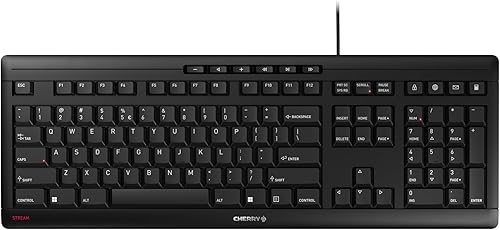
Cherry Stream Keyboard: Best for frequent office typing
- Wired USB-A connection
- Quiet scissor-key mechanism
- Numeric keypad
- 10 extra office and media keys
The Cherry Stream pairs a quiet scissor mechanism with a numeric keypad and extra office controls. Its wired connection suits desks where a cable is not a problem.
Pros
- Quiet scissor keys
- Extra office and media controls
- Rubber feet and integrated metal plate
Cons
- Wired connection
- Windows-focused compatibility
The Cherry Stream is aimed at frequent typists who want a wired keyboard with a more defined scissor-key feel. Its CHERRY SX mechanism is designed for precise typing, and Cherry describes the sound as whisper quiet.
Ten extra keys handle office and media actions such as opening a browser, locking the PC or controlling playback. Rubber feet and an integrated metal plate help keep the keyboard stable on a desk.
Choose it if the extra controls and steady wired design fit your workflow. For broader Bluetooth pairing or multiple devices, the K950 is a better match.
RECCAZR Wireless Keyboard and Mouse Combo Silent: Best for shared desks with a mouse
- Soft membrane keys
- Full-size keyboard with numeric keypad
- One receiver for keyboard and mouse
- Adjustable keyboard tilt legs
This combo keeps the keyboard and mouse on one USB receiver, leaving other ports free. Its soft membrane keys and quiet-click mouse are aimed at office and home use.
Pros
- Keyboard and mouse share one receiver
- Full-size layout
- Quiet mouse buttons
Cons
- Requires a USB receiver
- Battery life varies with use and conditions
The RECCAZR combo suits a desk where both keyboard and mouse noise matter. Its soft membrane keys are designed for quiet typing, and the mouse buttons are described as quiet click.
A single USB receiver connects both devices, so the combo uses one port rather than two. The full-size layout includes a number pad and multimedia shortcuts, while adjustable tilt legs let you change the typing angle.
Choose it if you want a full-size wireless combo and don't need Bluetooth. The keyboard and mouse use batteries, and their battery life can vary with use and conditions.
SOLAKAKA KI99 Pro Wireless Mechanical Keyboard: Best for quieter mechanical typing
- Silent switches
- Five noise-reducing layers
- 96% layout
- Bluetooth, 2.4 GHz or USB-C connection
The KI99 Pro offers a mechanical option with silent switches and five noise-reducing layers. Its 96% layout keeps a number section while taking up less space than a full-size board.
Pros
- Quiet switches and layered noise reduction
- Three connection modes
- Hot-swappable switches
Cons
- Mechanical design may take more setup than a basic office keyboard
- RGB lighting may not suit every office
The SOLAKAKA KI99 Pro is the mechanical option for an office that wants a more compact layout without giving up a number section. It has silent linear switches and five noise-reducing layers, along with a 96-key layout.
You can connect it by Bluetooth, 2.4 GHz wireless or USB-C. The switches are hot-swappable, so the keyboard also suits someone who wants the option to change switches later.
Choose this when you want mechanical customization and quiet-focused design together. For the simplest low-noise office setup, a membrane or scissor-key model may ask less of your attention.
ONIKUMA GAMING Tri-Mode Wireless Keyboard: Best for a compact shared workspace
- Silent membrane keys
- 94-key compact layout
- Bluetooth, 2.4 GHz or USB-C connection
- Multifunction control knob
The ONIKUMA saves desk space with a 94-key layout and uses membrane keys designed for quieter typing. Its tri-mode connections give you a choice of wireless or wired setup.
Pros
- Compact layout
- Three connection modes
- Silent membrane keys
Cons
- Smaller layout may need adjustment
- RGB lighting is not needed for every office
The ONIKUMA GAMING board suits a smaller desk or a shared space where a full-size keyboard takes up too much room. Its 94-key layout uses quiet membrane keys, and the connection can be Bluetooth, 2.4 GHz wireless or USB-C.
A control knob adjusts volume and lighting, and the keyboard includes an RGB backlight and a small display. Those extras are useful if you want controls at hand, though they are not needed for basic office typing.
Pick it when space and tri-mode connections matter more than a traditional full-size layout. If you regularly use a number pad, compare it with the full-size models first.
Kensington Slim Type Wired Keyboard: Best for laptop-style wired typing
- Slim scissor keys
- Full-size layout with numeric keypad
- USB connection
- Integrated tilt stands
The Kensington uses laptop-style scissor keys for quiet, precise typing in a full-size wired layout. Tilt stands let you raise the keyboard angle.
Pros
- Quiet scissor keys
- Numeric keypad
- No batteries needed
Cons
- Cable limits placement
- Older macOS compatibility details may need checking
The Kensington Slim Type gives you a full-size wired layout with laptop-style scissor keys. It has a numeric keypad, one-touch email and media controls, and tilt stands that raise the typing angle.
Its thin profile may suit someone who prefers a laptop-like key feel at a desktop. USB connectivity means there are no keyboard batteries to manage, but the cable ties it to the computer's location.
Choose it if you want a quiet scissor-style board with a familiar number pad. For more compact layouts, review our guide to the best quiet full size keyboard options.
OMOTON Purple Wireless Keyboard and Mouse Combo: Best for a phone-friendly Windows desk
- Quiet typing keys
- Full-size keyboard with phone holder
- One receiver connects keyboard and mouse
- Adjustable feet
The OMOTON pairs quiet typing with a built-in phone holder and a shared receiver for its keyboard and mouse. It's intended for Windows computers.
Pros
- Phone holder slot
- Keyboard and mouse share one receiver
- Adjustable typing angle
Cons
- Windows only
- Batteries are not included
The OMOTON is a Windows-focused wireless combo with quiet typing keys and a built-in phone holder. The slot keeps a phone in view, while a single USB receiver connects both the keyboard and mouse.
Its full-size layout includes a numeric keypad, and adjustable feet let you set the keyboard angle. The mouse has three DPI settings, which can suit different cursor preferences for documents or browsing.
Choose it if a phone holder and wireless combo are useful at your Windows desk. It is not the right pick for macOS or other systems, and the keyboard and mouse batteries are not included.
How we chose quiet keyboards for office work
We compared the features that affect shared office use: stated quiet-key designs, connection method, layout, and practical controls. Our score weighs specs, features and buyer feedback against what you're shopping for.
A quiet keyboard is only one part of a calmer workspace. If your calls pick up keystrokes, microphone placement and call software settings also matter.
What should you compare before choosing a quiet office keyboard?
Compare the keyboard's connection, key layout and typing style before choosing based on extra features. A useful office keyboard should fit your computer, your desk space and the way you enter text.
Is a quiet keyboard for office use better wired or wireless?
A wired keyboard is a good fit if you want a direct USB connection and leave your keyboard in one place. The HP 150, Cherry Stream and Kensington Slim Type all use a cable.
A wireless keyboard helps reduce visible cabling and can make it easier to shift a keyboard between work areas. Check whether your computer supports Bluetooth or has a free USB port for a receiver.
Does a quiet keyboard for work need a number pad?
A number pad is helpful for spreadsheets, bookkeeping and frequent number entry. Full-size models such as the MK335, K950 and HP 150 include one.
A compact keyboard can free up desk space if you rarely use the number pad. If you're deciding between common layouts, our what is a TKL keyboard guide explains the tradeoff.
Are mechanical keys suitable for a shared office?
Mechanical keyboards can work in shared offices when their switches and construction are designed to reduce sound. The KI99 Pro pairs silent switches with noise-reducing layers, though keyboard noise still depends on typing force and the desk surface.
For more detail on the choice, read are mechanical keyboards worth it. If gaming features matter too, our best quiet keyboard for gaming guide covers that use.
Should I choose a quiet Bluetooth keyboard for office work?
Bluetooth is useful if you want to connect without occupying a USB port or receiver. The K950 supports Bluetooth and can switch between three devices, while the MK335 uses a 2.4 GHz receiver.
If Bluetooth is your main requirement, compare our best quiet keyboard Bluetooth options before choosing. Check device compatibility and pairing support for your computer.
Which quiet keyboard should you choose for office work?
Choose the MK335 if you want quiet low-profile typing and a wireless mouse together. Pick the K950 for three-device switching, the HP 150 for wired simplicity, or the KI99 Pro if you want a mechanical design with silent switches.
For brand-specific options, see our best Logitech quiet keyboard guide. Your best quiet keyboard for office use is the one whose sound profile, connection and layout fit your desk and daily work.
Our top 3 picks at a glance
-
1
Best for a quiet wireless desk
Logitech MK335 Full Size Quiet Wireless Keyboard
9.7/10 our score
See it on Amazon -
2
Best for switching between devices
Logitech Signature Slim K950 Wireless Keyboard
9.6/10 our score
See it on Amazon -
3
Frequently asked questions
What makes a keyboard quiet enough for an office?
A quiet office keyboard uses keys designed to reduce typing noise, such as low-profile, membrane or scissor-style keys. The MK335, K950 and Cherry Stream all describe quiet typing features.
Noise still depends on how you type and the desk surface, so consider your team's call and shared-space needs.
Are mechanical keyboards too loud for an office?
Some mechanical keyboards have loud switches, but the switch type and noise-reducing design matter. The SOLAKAKA KI99 Pro combines silent switches with five noise-reducing layers.
If you want to understand the tradeoffs, read our guide on whether mechanical keyboards are worth it.
Should I choose a wired or wireless quiet keyboard for work?
Choose wired if you want a direct USB connection and don't mind a cable, as with the HP 150 or Cherry Stream. Wireless models reduce desk cabling and can connect through Bluetooth or a USB receiver.
Check your computer's available ports and connection support before choosing.
Do quiet office keyboards need a number pad?
A number pad helps if you often enter figures, but it takes more desk width. The full-size MK335, K950 and HP 150 include numeric layouts, while the 94-key ONIKUMA is more compact.
For a smaller layout, see our guide to what a TKL keyboard is.
How can I reduce typing noise during calls?
Start with a keyboard designed for quieter typing, then place it on a stable desk surface and avoid striking keys harder than needed. A quiet keyboard can reduce the sound reaching nearby coworkers, though it won't remove every keystroke from a close microphone.
Use a headset or adjust mic placement if keyboard sounds reach call audio.


