8 Best Wireless Ergonomic Keyboards (November 2026)
The best wireless ergonomic keyboards include the Logitech Wave Keys Ergonomic Wireless Keyboard for compact everyday typing, the Logitech Ergo K860 Wireless Ergonomic Split Keyboard for a full-size split layout, and the ULSOU Wireless Keyboard And Mouse Combo for a matched keyboard and mouse.
On this page (9 sections)
- How we chose wireless ergonomic keyboards
- Compare wireless ergonomic keyboard features
- The best wireless ergonomic keyboards by use
- Which wireless layout is right for your desk?
- Which connection should you choose?
- How should you compare wrist support and key shape?
- Do you need a specialized keyboard type?
- More guides on this topic
- Verdict: which wireless ergonomic keyboard should you choose?
The Logitech Wave Keys Ergonomic Wireless Keyboard is the best wireless ergonomic keyboard for most desks because its compact wave shape pairs with a cushioned palm rest and Bluetooth or Logi Bolt connectivity. For a full-size split layout, consider the Logitech Ergo K860; for a keyboard and mouse together, choose ULSOU.
A wireless ergonomic keyboard can connect over Bluetooth or through a USB receiver. The right option depends on your computer's ports, the number of devices you switch between, and whether you prefer a wave or split key layout.
If you're still deciding on layout and size, start with our best keyboard for computer guide. It covers the broader choices beyond ergonomic models.
Our picks at a glance
-
1
 Best for compact everyday typing
Logitech Wave Keys Ergonomic Wireless Keyboard
9.7/10 our score
See it on Amazon -
2
 Best for a full-size split layout
Logitech Ergo K860 Wireless Ergonomic Split Keyboard
9.6/10 our score
See it on Amazon -
3
 Best for a matched keyboard and mouse
ULSOU Wireless Keyboard And Mouse Combo
9.6/10 our score
See it on Amazon
- 4
 Check it
Arteck Split Ergonomic Keyboard with Palm Rest
Best for a rechargeable split keyboard - 5
 Check it
TECKNET Wireless Ergonomic Keyboard Rechargeable
Best for several device connections - 6
 Check it
EAYBLLY 2.4G Wireless Ergonomic Keyboard
Best for a built-in device holder - 7
 Check it
COLIKES Wireless Ergonomic Keyboard
Best for quiet typing with lighting - 8
 Check it
ProtoArc EK01 Plus Backlit Bluetooth Ergonomic Keyboard
Best for adjustable white backlighting
How we chose wireless ergonomic keyboards
We compared the listed layouts, wrist support, connection options and power types to match common desk needs. Our score weighs specs, features and buyer feedback against what you're shopping for.
Wireless does not always mean Bluetooth. Several picks use a USB receiver, while the Wave Keys, Ergo K860, TECKNET and ProtoArc offer Bluetooth as an option.
The Logitech Wave Keys leads for a compact wave shape and support for switching among devices. The Ergo K860 earns a close second for buyers who want a full-size curved split frame, while ULSOU makes sense when you need a mouse in the same set.
Compare wireless ergonomic keyboard features
The best wireless ergonomic keyboard for you depends on its layout, connection and built-in support. This table shows the main differences at a glance.
| Product | Best for | Layout | Connection | Wrist support | Our score |
|---|---|---|---|---|---|
| Logitech Wave Keys Ergonomic Wireless Keyboard | compact everyday typing | Wavy, compact QWERTY | Bluetooth or Logi Bolt Receiver | Cushioned memory foam palm rest | 9.7 |
| Logitech Ergo K860 Wireless Ergonomic Split Keyboard | a full-size split layout | Full-size curved split QWERTY | Bluetooth or USB receiver | Pillowed wrist rest with adjustable palm lift | 9.6 |
| ULSOU Wireless Keyboard And Mouse Combo | a matched keyboard and mouse | Full-size wave QWERTY | 2.4 GHz USB receiver | 9.6 | |
| Arteck Split Ergonomic Keyboard with Palm Rest | a rechargeable split keyboard | Split QWERTY with number pad | 2.4 GHz nano USB receiver | 9.5 | |
| TECKNET Wireless Ergonomic Keyboard Rechargeable | several device connections | Split curved arrangement | Bluetooth or 2.4 GHz USB dongle | Integrated memory foam wrist rest | 9.0 |
| EAYBLLY 2.4G Wireless Ergonomic Keyboard | a built-in device holder | Full-size wave QWERTY | 2.4 GHz wireless | 8.8 | |
| COLIKES Wireless Ergonomic Keyboard | quiet typing with lighting | Wave QWERTY | 2.4 GHz USB wireless | 8.5 | |
| ProtoArc EK01 Plus Backlit Bluetooth Ergonomic Keyboard | adjustable white backlighting | Full-size curved split QWERTY | Bluetooth or 2.4 GHz USB | 8.3 |
The best wireless ergonomic keyboards by use
These wireless ergonomic keyboard picks cover compact wave designs, full-size split layouts, receiver-based sets and backlit options. Match the layout and connection to your daily desk setup.
Logitech Wave Keys Ergonomic Wireless Keyboard: Best for compact everyday typing
- Wavy compact layout
- Cushioned memory foam palm rest
- Bluetooth or Logi Bolt Receiver
- Easy-Switch for up to 3 devices
A familiar compact layout combines a wavy key shape with a cushioned palm rest. Bluetooth and Logi Bolt options make it a flexible pick for a desk shared by several devices.
Pros
- Bluetooth and receiver connection options
- Switches among up to 3 devices
- Ergo-certified by United States Ergonomics
Cons
- Compact layout differs from a full-size split keyboard
- Palm rest is built into the keyboard
The Logitech Wave Keys fits a desk where a full split keyboard would feel too large or unfamiliar. Its wavy compact shape positions hands, wrists and forearms in what Logitech describes as a natural typing position.
A cushioned memory foam palm rest adds support at the front edge. That can be useful if you like a built-in rest, though people who prefer a separate or no-rest setup should compare the keyboard's footprint with their desk.
For wireless connection, choose Bluetooth or the Logi Bolt Receiver. Easy-Switch lets you move among a laptop, tablet and phone, with support for up to 3 devices.
Choose it for compact wave keys and multi-device switching. If you want a more clearly separated key layout, compare our best ergonomic split keyboard picks.
Logitech Ergo K860 Wireless Ergonomic Split Keyboard: Best for a full-size split layout
- Curved split keyframe
- Pillowed memory foam wrist rest
- Bluetooth or USB receiver
- Three palm-lift angles
The Ergo K860 offers a full-size curved split layout, integrated numpad and a pillowed wrist rest. Its adjustable palm lift has 0, -4 and -7 degree positions.
Pros
- Bluetooth and USB receiver connections
- Three palm-lift positions
- Ergonomist approved by United States Ergonomics
Cons
- Full-size design takes more desk space
- Split layout may take adjustment
The Logitech Ergo K860 is the strongest fit here for a full-size split keyboard with adjustable wrist positioning. Its curved split keyframe pairs with a pillowed wrist rest, and tilt legs provide 0, -4 and -7 degree palm-lift positions.
The full-size layout includes a numpad and quiet keys. Connect by Bluetooth or USB receiver, then use Logitech Options to customize Fn keys and shortcuts.
This layout takes more room than the compact Wave Keys, so measure your available desk space. If you want an ergonomic setup for games, see our best ergonomic keyboard for gaming guide.
ULSOU Wireless Keyboard And Mouse Combo: Best for a matched keyboard and mouse
- Wave keyboard with wrist rest
- Contoured right-hand mouse
- Shared 2.4 GHz USB receiver
- Adjustable keyboard stand
The ULSOU set pairs a wave-style keyboard with a contoured right-hand mouse, using one 2.4 GHz receiver for both. It suits a desktop setup that needs both input devices.
Pros
- Keyboard and mouse use one receiver
- Adjustable keyboard stand
- Works with Windows and macOS
Cons
- Requires an available USB port
- Keyboard and mouse each need an AA battery
The ULSOU combo suits a desktop that needs both a keyboard and mouse, with one receiver connecting both devices. Its wave keyboard includes a wrist rest and adjustable stand, while the right-hand mouse has a contoured shape and forward and back buttons.
The 2.4 GHz receiver is stored on the back of the mouse. The keyboard and mouse each need one AA battery, which isn't included, and the set supports Windows and macOS.
This is a practical option if you prefer a matched set and want to keep the computer's USB setup simple. For a laptop-specific shortlist, see our best ergonomic keyboard for laptop guide.
Arteck Split Ergonomic Keyboard with Palm Rest: Best for a rechargeable split keyboard
- Split key design
- Cushioned wrist and palm rest
- 2.4 GHz nano USB receiver
- Rechargeable lithium battery
Arteck combines a three-section split layout with a cushioned wrist rest and rechargeable battery. The nano receiver stores at the back of the keyboard.
Pros
- Rechargeable battery
- Receiver stores in the keyboard
- Foldable legs adjust the typing angle
Cons
- Windows layout can differ on Mac
- Wireless connection uses a USB receiver
The Arteck Split Ergonomic Keyboard is a receiver-based choice for a rechargeable split layout. Its three-section key design aims to position wrists and forearms in a relaxed position, and the cushioned rest supports the wrist and palm.
The nano USB receiver is stored behind the keyboard. Arteck says its rechargeable lithium battery lasts up to 6 months based on 2 hours of continuous use per day.
Foldable legs let you adjust the typing angle. Arteck notes that the keyboard uses a Windows layout, so some keys and functions differ on Mac.
TECKNET Wireless Ergonomic Keyboard Rechargeable: Best for several device connections
- Split curved key arrangement
- Bluetooth and 2.4 GHz receiver
- Pairing memory for up to 3 Bluetooth devices
- Rechargeable with USB-C
TECKNET supports Bluetooth pairing memory for up to 3 devices and also includes a 2.4 GHz USB dongle. Its split curved layout has four-stage adjustable feet.
Pros
- Bluetooth and receiver connection options
- Rechargeable over USB-C
- Four tilt settings
Cons
- Compatibility details focus on Windows computers
- The full-size layout needs desk space
The TECKNET keyboard stands out for pairing with several devices and offering two wireless connection paths. It supports Bluetooth pairing memory for up to 3 devices, plus a 2.4 GHz USB dongle.
Its split curved key arrangement and integrated memory foam wrist rest are designed to keep the hands at shoulder width. Four foot positions adjust the angle, and USB-C charging supports use while charging.
The listed compatibility focuses on Windows computers, so check device support before choosing it for another operating system. If you need a simpler setup without wireless pairing, compare our best wired ergonomic keyboard guide.
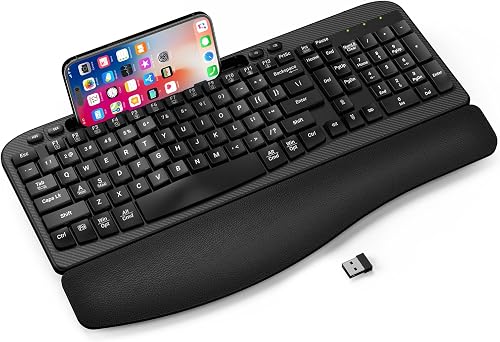
EAYBLLY 2.4G Wireless Ergonomic Keyboard: Best for a built-in device holder
- Wave-shaped keys
- Memory foam wrist rest
- Built-in 7.28 in device holder
- 2.4 GHz connection with USB-C adapter
EAYBLLY adds a wide holder for a phone or small tablet to its full-size wave keyboard. It connects through 2.4 GHz wireless and includes a USB-C adapter.
Pros
- Device holder built into the keyboard
- Memory foam cushioned palm rest
- Compatible with Windows, Mac OS and Chrome OS
Cons
- Uses one AA battery
- Wireless connection needs a USB port or included adapter
EAYBLLY adds a phone or small tablet holder to a full-size wave keyboard. The built-in 7.28 in slot supports vertical or horizontal placement, which can keep a second screen close while you work.
The keyboard uses a 2.4 GHz wireless connection and includes a USB-C adapter for Windows, Mac OS and Chrome OS. Its wave keys sit above a memory foam wrist rest, with dual tilt angles.
It needs one AA battery, which isn't included. Choose this model if the device holder is useful at your desk, rather than paying attention to it as a general ergonomic feature.
COLIKES Wireless Ergonomic Keyboard: Best for quiet typing with lighting
- Wave layout with soft wrist rest
- 15 RGB lighting effects
- Rechargeable battery
- 2.4 GHz USB receiver
COLIKES combines a wave shape and soft wrist rest with quiet membrane keys and adjustable RGB lighting. It recharges over USB-C and uses a USB receiver for its wireless connection.
Pros
- 15 lighting effects and 3 brightness levels
- Rechargeable over USB-C
- Receiver stores on the keyboard
Cons
- Backlight use shortens the stated battery runtime
- Needs a USB receiver connection
The COLIKES keyboard is a wave-style option for quiet typing and adjustable lighting. Its membrane keys and soft wrist rest are paired with 15 RGB effects and three brightness levels.
It connects through a 2.4 GHz USB receiver and charges over USB-C. COLIKES gives different runtime estimates with the backlight off and on, so expect more frequent charging if you keep the lighting active.
The receiver stores on the keyboard, and the USB-C adapter supports devices with that port. For a low-noise shortlist, see our best quiet ergonomic keyboard guide.
ProtoArc EK01 Plus Backlit Bluetooth Ergonomic Keyboard: Best for adjustable white backlighting
- Curved split frame
- Bluetooth and 2.4 GHz USB connection
- Connects to up to 3 devices
- Three white backlight levels
ProtoArc combines a full-size curved split layout and cushioned wrist rest with adjustable white backlighting. It can pair with up to 3 devices through Bluetooth and 2.4 GHz USB.
Pros
- Connects to up to 3 devices
- Three backlight brightness levels
- Rechargeable 2000mAh battery
Cons
- Backlight reduces battery runtime
- Cannot be connected by wire
The ProtoArc EK01 Plus combines a curved split frame with soft white backlighting. Its full-size layout and cushioned wrist rest suit buyers who want a more structured design, while three brightness levels help adjust the keys for a dim room.
Bluetooth and 2.4 GHz USB let it connect to up to 3 devices. The rechargeable 2000mAh battery powers the keyboard, but using the backlight reduces the stated runtime.
The keyboard cannot connect by wire, so plan to use Bluetooth or its receiver. If you need a Mac-focused shortlist, see our best ergonomic keyboard for Mac guide.
Which wireless layout is right for your desk?
A wave layout keeps the key groups close while changing the rows' shape. A split layout separates the groups and may suit buyers who want a more pronounced change in hand position.
Wave Keys and ULSOU are wave-style picks. The Ergo K860, Arteck, TECKNET and ProtoArc use split designs, with differences in wrist support, device connections and size.
For a broader look at work-focused layouts, see our best ergonomic keyboard for office guide. If you prefer a model that connects directly by cable, our best wired ergonomic keyboard guide covers that path.
Which connection should you choose?
Bluetooth is useful when you want to leave a USB port free or switch among several paired devices. Wave Keys, Ergo K860, TECKNET and ProtoArc offer Bluetooth connectivity.
A USB receiver can be a straightforward choice for a desktop computer with an available port. ULSOU's receiver works with both the keyboard and mouse, while Arteck, EAYBLLY and COLIKES rely on receiver-based wireless connections.
For more Bluetooth options, browse our best bluetooth keyboard ergonomic guide. If lighting matters, our best ergonomic keyboard backlit guide compares models with illuminated keys.
How should you compare wrist support and key shape?
A built-in palm rest gives you one less accessory to place on the desk, but the feel and shape vary. Wave Keys has a cushioned memory foam rest, while Ergo K860 and ProtoArc use curved rests with split layouts.
Check the keyboard's tilt adjustment as well as the wrist rest. The Ergo K860 has three palm-lift positions, Arteck has foldable legs, and TECKNET offers four foot positions.
A split layout can change where your hands sit, but no one shape fits every person. If you have small hands, read our best ergonomic keyboard for small hands guide before choosing a full-size design.
Do you need a specialized keyboard type?
A wireless ergonomic board can be a good everyday option, but some buyers need a specific key feel or desk setup. Mechanical designs use a different switch feel, and a keyboard without a wrist rest may suit someone who already uses a separate support.
Our best ergonomic mechanical keyboard guide covers mechanical options. For buyers who want to choose their own wrist support, see best ergonomic keyboard with no wrist rest.
People shopping around a health concern may also want to compare fit carefully. Our best ergonomic keyboard for arthritis and best ergonomic keyboard for carpal tunnel guides focus on those searches, but no keyboard can promise a medical outcome.
More guides on this topic
- Best Keychron Ergonomic Keyboards
Verdict: which wireless ergonomic keyboard should you choose?
Choose the Logitech Wave Keys if you want a compact wave layout, built-in cushioned palm rest and Bluetooth or receiver options. Pick the Ergo K860 for a full-size split keyboard with adjustable palm lift, or choose ULSOU when you need a wireless mouse in the same set.
For a more focused Bluetooth shortlist, use our best bluetooth keyboard ergonomic guide. Match the connection and layout to your computer and desk before you decide.
Our top 3 picks at a glance
-
1
Best for compact everyday typing
Logitech Wave Keys Ergonomic Wireless Keyboard
9.7/10 our score
See it on Amazon -
2
Best for a full-size split layout
Logitech Ergo K860 Wireless Ergonomic Split Keyboard
9.6/10 our score
See it on Amazon -
3
Best for a matched keyboard and mouse
ULSOU Wireless Keyboard And Mouse Combo
9.6/10 our score
See it on Amazon
Frequently asked questions
What should you check before choosing a wireless ergonomic keyboard?
Check the keyboard shape, connection type, wrist support and space on your desk. A wave layout changes the key rows without splitting the keyboard, while a curved split layout separates the key groups.
Also confirm whether your computer supports Bluetooth or has an open USB port for a receiver.
Is Bluetooth or a USB receiver better for an ergonomic keyboard?
Bluetooth avoids using a USB port and can pair with multiple devices on some models. A 2.4 GHz receiver is a direct option for computers with USB ports, but it occupies a port unless the keyboard shares its receiver with a mouse.
Pick the connection your computer can use reliably.
Do wireless ergonomic keyboards include wrist rests?
Many models in this roundup include a cushioned or integrated wrist rest, but designs vary. Logitech Wave Keys has a cushioned memory foam palm rest, while the Ergo K860 has a pillowed wrist rest and adjustable palm lift.
Check whether a built-in rest fits your desk and typing position.
Are split ergonomic keyboards hard to learn?
A split layout places the key groups farther apart than a standard keyboard, so it may feel unfamiliar at first. The Ergo K860, Arteck and ProtoArc picks use split designs.
If you prefer a layout closer to a conventional keyboard, a wave-shaped model may be an easier transition.
Can one wireless ergonomic keyboard connect to multiple devices?
Yes, some models support multiple device connections. Logitech Wave Keys can switch among up to 3 devices, TECKNET keeps Bluetooth pairing memory for up to 3, and ProtoArc connects to up to 3 through Bluetooth and 2.4 GHz USB.
Confirm the switching method matches how you use your devices.